


🧪 Chemical Structure of Bitumen and Its Constituents
Bitumen is a complex petroleum-derived material composed of a wide range of organic compounds. Hydrocarbons make up the major part of its chemical composition; however, compounds containing sulfur, nitrogen, and oxygen, as well as varying amounts of metals, are also present. The exact composition of bitumen depends on the origin of the crude oil, the refining methods, and the manufacturing processes employed.
🔬 Major Chemical Classes in Bitumen
- 🧬 Aliphatic Compounds: Hydrocarbons with straight or branched carbon chains, such as alkanes.
- ⚗️ Cycloaliphatic Compounds: Hydrocarbons containing saturated or unsaturated ring structures, such as cyclohexane and cyclohexene.
- 🔗 Aromatic Compounds: Compounds containing aromatic ring systems, including polycyclic aromatic hydrocarbons.
In addition to these groups, bitumen contains heterocyclic compounds incorporating atoms such as sulfur, nitrogen, and oxygen. The diversity of these compounds, together with their differences in molecular weight, polarity, and structure, makes the comprehensive identification and characterization of bitumen chemically challenging.
🧫 1. Molecular Structure and Constituents of Bitumen
Various analytical techniques are used to investigate the composition of bitumen, each providing information about specific properties of the material. These techniques include elemental analysis, spectroscopy, chromatography, and tests for determining physical and rheological properties.
One widely used approach for characterizing bitumen components is SARA analysis, which separates bitumen into four operationally defined fractions based on their solubility and chromatographic behavior:
- ⚫ Saturates: Predominantly saturated hydrocarbon compounds.
- 🟠 Aromatics: Compounds containing aromatic structures.
- 🟤 Resins: Relatively polar compounds that contribute to interactions among bitumen components.
- ⚫ Asphaltenes: A complex fraction of compounds generally characterized by relatively high molecular weight and polarity, which influence the structure and behavior of bitumen.
The properties of these fractions and their interactions influence the overall behavior of bitumen. For example, asphaltenes, together with resins and other bitumen fractions, contribute to its internal structure and flow characteristics.
🔍 Molecular Size and Hydrodynamic Size
Molecular size and hydrodynamic size are important concepts in the study of complex molecular systems. Hydrodynamic size refers to the effective size of a molecule or molecular assembly moving through a fluid. It can be influenced by molecular shape, intermolecular interactions, solvent type, and temperature.
In bitumen, studying molecular behavior and interactions among its components helps improve our understanding of its physical and mechanical properties. However, hydrodynamic size should not be confused with actual molecular dimensions or molecular weight. It is also dependent on the measurement technique and experimental conditions.
⚙️ 2. Bitumen Rheology and Its Relationship with Chemical Structure
Rheology is the branch of science concerned with the flow and deformation of materials under different conditions. Since bitumen exhibits viscoelastic behavior, its properties reflect both the viscous response associated with flow and the elastic response associated with deformation and recovery.
📌 Factors Affecting the Rheological Properties of Bitumen
- 🧪 Chemical Composition: The types and proportions of the constituent fractions.
- 🧬 Molecular Structure: The size, shape, polarity, and characteristics of the molecules.
- 🔗 Intermolecular Interactions: Forces that influence the arrangement and movement of bitumen components.
- 🌡️ Temperature: Increasing temperature generally reduces bitumen viscosity.
- ⚙️ Loading Conditions: The duration of loading, rate of deformation, and type of applied stress.
Understanding the relationship between chemical structure, the physical arrangement of molecules, and rheological behavior is essential for evaluating bitumen performance in industrial and road construction applications. These relationships are also important when investigating changes caused by aging, oxidation, and modification with additives.
🧪 3. Chemical Composition of Bitumen
3.1 🔬 Elemental Analysis of Bitumen
Elemental analysis is an important technique for investigating the chemical composition of bitumen. It determines the proportions of its principal elements; however, it cannot independently establish the exact molecular structures or identify every compound present.
Bitumen consists primarily of carbon and hydrogen. Variable amounts of sulfur, oxygen, and nitrogen are also present, together with trace metals such as vanadium, nickel, and iron.
📊 Table 1. Elemental Composition of Bitumens from Various Sources
The following values are reported in the Shell Bitumen Handbook and represent the ranges and averages observed in bitumens from different sources.
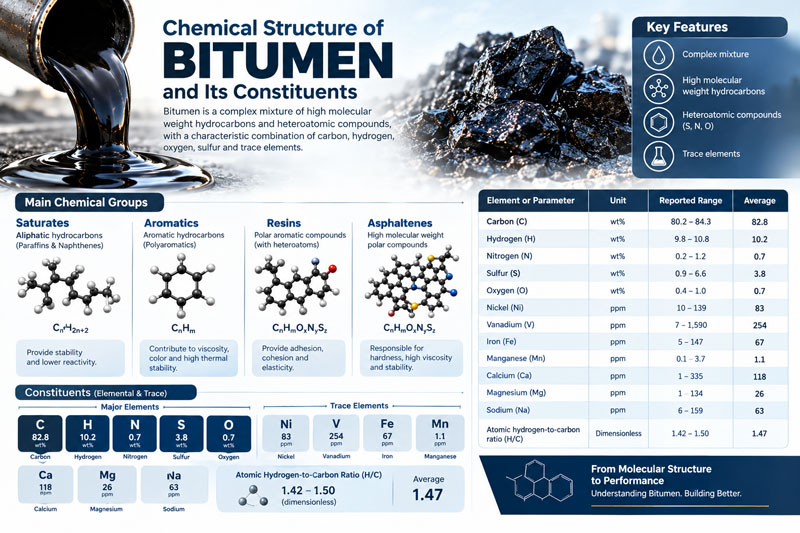
| Element or Parameter | Unit | Reported Range | Average |
|---|---|---|---|
| Carbon (C) | wt% | 80.2–84.3 | 82.8 |
| Hydrogen (H) | wt% | 9.8–10.8 | 10.2 |
| Nitrogen (N) | wt% | 0.2–1.2 | 0.7 |
| Sulfur (S) | wt% | 0.9–6.6 | 3.8 |
| Oxygen (O) | wt% | 0.4–1.0 | 0.7 |
| Nickel (Ni) | ppm | 10–139 | 83 |
| Vanadium (V) | ppm | 7–1,590 | 254 |
| Iron (Fe) | ppm | 5–147 | 67 |
| Manganese (Mn) | ppm | 0.1–3.7 | 1.1 |
| Calcium (Ca) | ppm | 1–335 | 118 |
| Magnesium (Mg) | ppm | 1–134 | 26 |
| Sodium (Na) | ppm | 6–159 | 63 |
| Atomic hydrogen-to-carbon ratio (H/C) | Dimensionless | 1.42–1.50 | 1.47 |
Technical note: wt% means weight percent, while ppm means parts per million. For mass concentrations, 1 ppm is equivalent to 1 mg/kg. These figures represent reported reference data and are not guaranteed specifications for every bitumen grade. Actual composition varies with crude oil origin, refining processes, and product characteristics.
3.2 ⚗️ The Role of Elements in Bitumen Structure
🟤 Carbon and Hydrogen: These two elements form the principal hydrocarbon framework of bitumen. Their proportions and the types of chemical bonds present influence its chemical and physical characteristics.
🟡 Sulfur: Sulfur occurs in various organic compounds, and its concentration depends on crude oil origin and refining processes. The types of sulfur-containing compounds can also influence the chemical characteristics of bitumen.
🔴 Oxygen: Oxygen is present in certain organic functional groups. Oxidation can also increase the formation of oxygen-containing compounds in bitumen. These changes may be associated with increased stiffness and changes in rheological behavior.
🔵 Nitrogen: Nitrogen is generally present in organic compounds containing specific functional groups or heterocyclic structures. Its concentration and chemical form vary among bitumens from different sources.
3.3 🧲 Metals Present in Bitumen
Bitumen may contain small quantities of metals such as vanadium, nickel, iron, calcium, magnesium, and sodium. Their concentrations depend on the composition of the original crude oil and the refining processes applied.
Some metals, particularly vanadium and nickel, can occur in complex organic structures, including metalloporphyrins. Porphyrins are cyclic compounds with distinctive chemical structures capable of binding certain metal ions.
🌿 Well-known examples of porphyrin-related structures include those found in chlorophyll and the heme group of hemoglobin. However, these biological compounds are not identical in structure or function to the metal complexes found in petroleum-derived materials.
The presence of metals in bitumen is relevant to crude oil characterization, chemical analysis, and the evaluation of certain refining processes. Their concentrations can be measured using appropriate instrumental analytical techniques.
✅ 4. Conclusion
Bitumen is a complex mixture of hydrocarbons and other organic compounds containing additional elements. Its elemental composition, molecular structure, and intermolecular interactions, together with temperature and loading conditions, influence its physical and rheological behavior.
Consequently, a comprehensive understanding of a bitumen sample cannot be obtained from elemental percentages or a single analytical test alone. Combining elemental analysis, molecular characterization techniques, and performance-related testing provides a more complete understanding of bitumen properties and potential applications.